

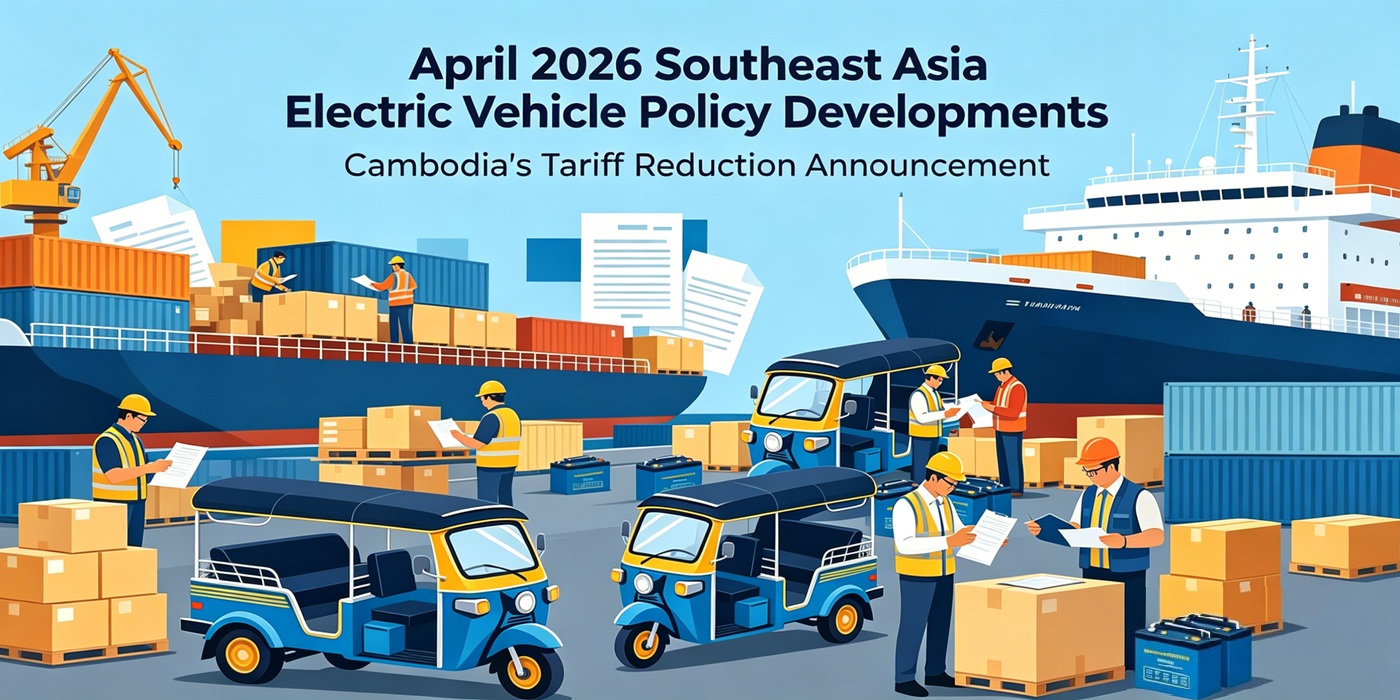
April 2026 has brought major policy developments across Southeast Asia that are reshaping the region's electric vehicle landscape — creating significant opportunities for electric tricycle exporters.
Cambodia took the most dramatic step. Effective April 1, 2026, the Cambodian government announced a sweeping tariff reduction under the Royal Government's Sub-Decree No. 52, covering 293 tariff lines including electric vehicles (EVs), solar equipment, and lithium batteries. Import duties on EV motors, solar systems, lithium batteries, and numerous energy storage devices have been slashed from 15 percent to zero, while EV charging equipment now enters Cambodia duty-free.
This push for green mobility extends beyond tariffs. Cambodia's Ministry of Public Works and Transport announced that beginning in 2026, all electric vehicles — including electric two-wheelers, electric tricycles, and electric cars — will be required to display special green license plates with green 'EV' identifiers to distinguish them from conventional fossil-fuel vehicles. According to government data, registered electric vehicles in Cambodia surged from 3,508 units in 2024 to 10,568 units by September 2025, and the National Electric Vehicle Development Policy 2024–2030 targets 20,000 electric tricycles on Cambodian roads by 2030.
Meanwhile, Indonesia experienced a sudden policy reversal. On April 17, the Indonesian Home Ministry issued Regulation No. 11/2026, ending automatic tax exemptions for electric vehicles and giving regional governments authority to set their own motor vehicle tax (PKB) and transfer fee (BBNKB) rates. Within days, facing backlash from manufacturers and economists who viewed the move as inconsistent with Indonesia's push to become a global EV hub, the government walked back the regulation. The episode highlights Indonesia's ongoing balancing act between revenue generation and supporting its growing EV sector, where sales surged 95.9 percent year-on-year in Q1 2026, reaching 33,150 units.
For electric tricycle manufacturers targeting Southeast Asia, these policy signals are clear. Cambodia's zero-tariff environment creates an immediate competitive advantage for importers, while Indonesia's policy volatility suggests that consistent, durable products will retain strong demand regardless of tax fluctuations.
Guangxi Dachuan Vehicle Co., Ltd. is strategically positioned to capitalize on these market shifts. The company's stainless steel electric tricycles — engineered specifically for humid climates and coastal conditions — are manufactured to never rust, ensuring long service life even under the region's tropical humidity. With 1.5m and 1.6m stainless steel e-trike models available in a premium silver finish, the product lineup meets the durability requirements of Southeast Asian buyers. The company also welcomes OEM/ODM orders, enabling distributors to customize battery configurations, cargo bed accessories, and color accents to match local preferences.
As ASEAN continues its green energy transition and with regional bodies advancing harmonized EEC certification standards for electric motorcycles and tricycles, the market entry pathway for compliant electric tricycle manufacturers has never been clearer. Guangxi Dachuan invites global partners to contact us for OEM/ODM inquiries and to explore the rapidly growing Southeast Asian e-trike market together.









 Fred
Fred